25th August 2026
Let’s Talk Grief: Theories of Grief (Part 1)


Grief can be messy and unpredictable, and there’s no single way to understand or experience it. Over the years, different theories have been developed to help make sense of some of the feelings and experiences that can come with bereavement.
In the first of two Let’s Talk Grief articles exploring grief theories, Jenni Tompkins, Bereavement Service Lead at Nottinghamshire Hospice, looks at the Stages of Grief Theory, what the different stages can involve, and why they are better understood as common experiences rather than a fixed path to follow.
Understanding grief theories
When we’re working with grief and loss, there are several theories and models that we utilise to help us understand how people are processing their experience. Whilst every grief is unique, there are themes or commonalities between people’s stories that help us to normalise the intensity of the feeling, so that those we work with feel less alone while we explore their personal griefscape with them.
Grief is not one size fits all
There are a couple of things to bear in mind. Firstly, these are all psychological theories, not facts. Whilst they might make sense to some people, to others, they won’t match up to their experience at all. That’s ok, and it’s the reason we develop an understanding of multiple theories, because grief most definitely is not one size fits all!
Secondly, if these theories don’t fit for you, that doesn’t mean that there is something ‘wrong’ with your grief. There might be elements of these theories that make sense, but not the whole thing, or it might just be that you’re still early in your process and not in a place to see the ‘big picture’ of your grief yet. Perhaps the relationship that you’re grieving was complex in a way that isn’t reflected by these theories. All of this is ok. Grief is not just one thing, and sometimes it will take time to make sense of.
The stages theory of grief
The theory that most people tend to have heard of is the ‘Stages’ theory of grief.
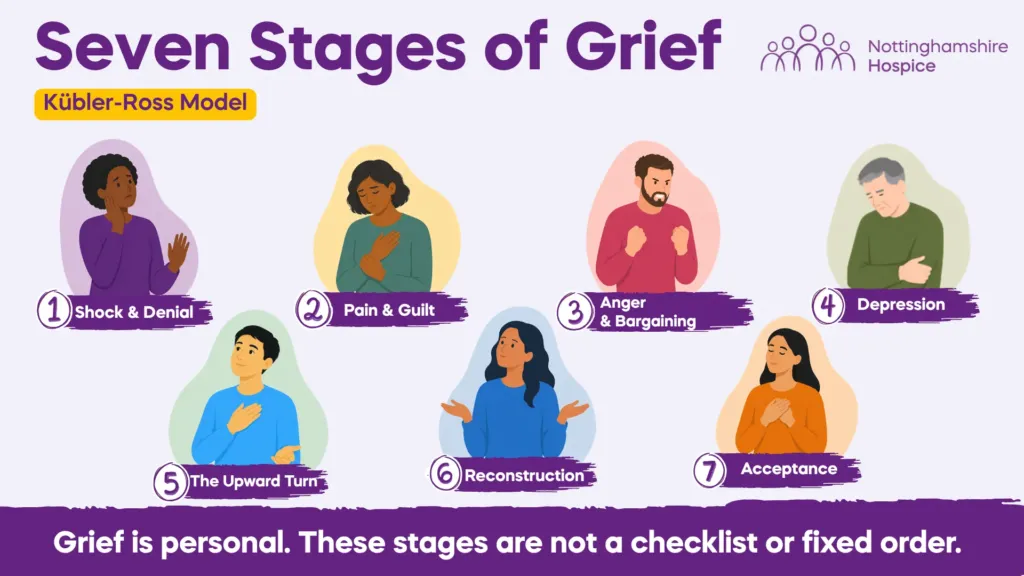
Elizabeth Kübler-Ross developed this theory in 1969, and it remains popular to this day. It describes certain stages or commonalities in the experience of grief that many people encounter. Whilst the stages are set out in a specific order, it’s important that we don’t assume that they will happen in this order. People will sometimes ask “what stage do you think I’m at?”, and it’s actually an unhelpful question, because what they really want to know is “is it nearly over?”.
The honest answer is that I have no idea, because the stages rarely happen in a specific order. They can be re-visited over time, because grief is messy and unpredictable, but most importantly, reaching the ‘last’ stage doesn’t mean it’s over.
Grief is a lifelong process of adjustment, and sometimes that’s the thing we have to come to accept as much as the loss.
Shock & Denial
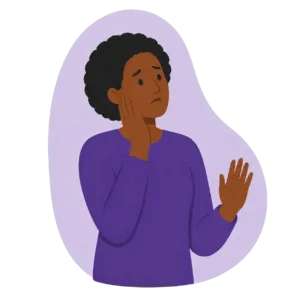
So, the stages themselves. Firstly, we have Shock & Denial. This stage can feature numbness, a need to ‘carry on as normal’, the feeling that the person who died is about to walk into a room, and the sense of ‘looking for’ the person when out and about. Essentially, it’s describing that sense of resistance to the idea that a death has occurred, and our struggle to accept that as reality.
Pain and Guilt
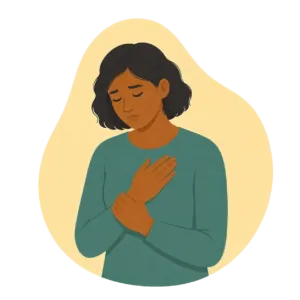
Next up, we have Pain & Guilt. This is where those really unhelpful ‘what if?’ scenarios play over and over in your head, and hindsight becomes a big stick with which to bash yourself: if only I had… what if they had… I should have… etc.
The difficulty is that it’s very easy to get stuck on these ‘what ifs’. It’s unhelpful because we can’t change what happened, and unfortunately, we seem to be better at remembering the things we didn’t do than all the things that we did do!
Anger & Bargaining

The next stage discussed is Anger & Bargaining. This is an interesting one, in that I’ve encountered very mixed reactions towards anger in grief. Sometimes this is directed inwards, and people will be angry with themselves, for many different reasons.
Sometimes it will be directed towards others, for instance care providers, hospitals or others who are perceived as having let down or ‘failed’ the family in some way.
Occasionally, the anger will be directed towards the person who has died, for having ‘left’ the grieving person alone.
Depression

Depression is a stage where we classify the low feelings and intensity of sadness that can accompany a bereavement. This does not mean clinical depression; it’s more a way to acknowledge that this feeling is both normal and part of the process. Life might feel as though it no longer holds meaning, there may be changes in appetite, sleeping patterns, behaviours, that will have elements of depressive or anxious symptoms.
This is 100% normal and what we would expect to see, particularly in the first 6 months after a death has occurred.
When we talk about bargaining, this is referring to that sense of feeling that you would do anything to have that person back again. Realistically, you know it’s not going to happen, but there is still that small part hoping it has all been a terrible dream.
The Upward Turn, Reconstruction and Acceptance
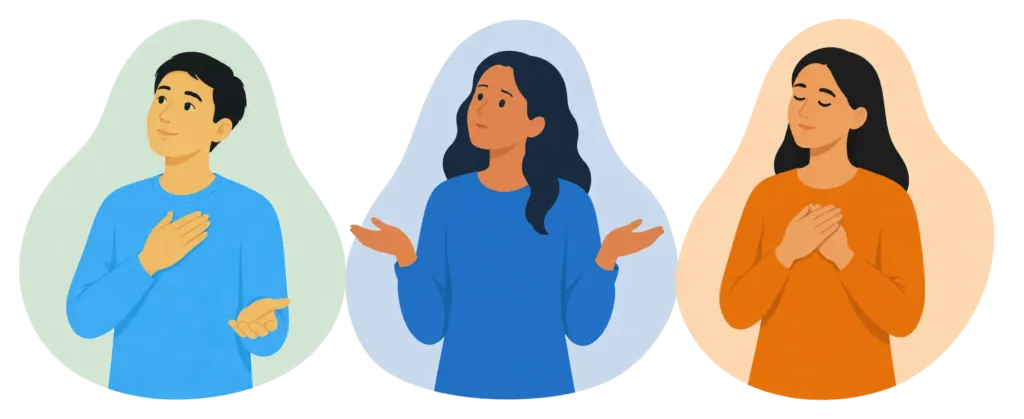
The final three ‘stages’ are a way to describe subtle changes in the ability to accept the reality of the situation and adjust to that new normal:
The Upward Turn is about starting to understand what you want the new normal to look like, because there is a choice, and it’s possible to be an active participant in making a desired change. This doesn’t have to be a huge, life-altering change – something like taking up a new hobby or joining a new group can have enough of a positive impact to make a difference.
Reconstruction is the active process of putting any changes into effect and achieving a healthier balance between reflection on the loss and distraction from the pain of grief.
Acceptance is about coming to accept the reality of what’s happened, feeling a measure of calm and finding a way to carry out everyday life without the emotional overwhelm that can make grieving so hard.
Grief is not a straight line
Because we tend to think of the stages as happening in this order, it’s tempting to think that this is the end of the process, and we arrive at acceptance ‘cured’ of grief.
In reality, it’s pretty rare for the stages to follow a linear path, and they can lead back into one another. For instance, the upward turn can frequently lead us right back to guilt, when we realise that we feel a bit less devastated than we did at the start, and beat ourselves up for not caring as much as we ‘should’.
That’s completely normal, and something that is very often brought up in our groups!
Not everyone experiences every stage
It’s also not necessarily true that everyone will experience all of these stages. Many people skip over or never experience several of them. Again, that’s ok, because it’s probably more helpful to think of these as ‘commonalities’ than stages. This is merely a way for us to understand what’s happening and to normalise the process, because it can be completely overwhelming, especially in the very early months.
Whatever stage people feel themselves to be in, we can offer support and understanding, as well as a listening ear to allow people to explore what is happening for them in their own unique grief journey.
Counselling and Emotional Support from Nottinghamshire Hospice
If this article has raised anything for you, or if you or someone you know is grieving, you don’t have to face it alone. Nottinghamshire Hospice offers free counselling and emotional support, including one-to-one sessions and peer support groups. Our team is here to help you find the support that feels right for you.
Find out more about our counselling and emotional support here or call us on 0115 962 1222