27th October 2026
Let’s Talk Grief: Disenfranchised Grief

Grief can be difficult enough without feeling that other people don’t recognise or understand what you are grieving. Some losses are more readily acknowledged than others, but that doesn’t make the feelings connected to them any less real.
In this Let’s Talk Grief article, Jenni Tompkins, Bereavement Service Lead at Nottinghamshire Hospice, explores disenfranchised grief – why some experiences of loss can be harder to acknowledge openly, and how we can respond to our own grief and the grief of others with greater understanding.
What is disenfranchised grief?
I often overhear conversations that take place around me, both at work and when I’m out and about (because I’m nosy… sorry, not sorry). One of the things that has come up a few times over the past couple of months is discussion around disenfranchised grief. Very rarely will people actually call it this, or necessarily even be aware that there is a term for what they are talking about, but whether aware of it or not, it is a thing that is experienced by many people.
Have you ever felt grief for someone or something that your friends, family or work colleagues rolled their eyes over? Or maybe they shared your grief, but not for very long, and after they ‘moved on’, they expected the same of you? What if your grief was for someone you didn’t know personally, like a celebrity, but who you felt was an important influence or inspiration in your life? How about the grief you felt when a beloved pet died? Did you find that after a while your grief became something that other people poked fun at or ridiculed, because they don’t/can’t/won’t try to understand it?
All of these are examples of what we call ‘disenfranchised grief’. It’s a term we use to distinguish those who are experiencing a grief that is very real to them, but that is minimised or less recognised by other people, meaning that they feel less able to openly acknowledge the feelings they carry.
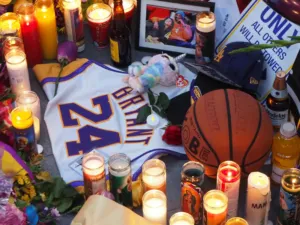
Photo – A public memorial for Kobe Bryant at Staples Center in Los Angeles.: Luke Harold via Wikimedia Commons, released under CC0 1.0.
When grief is minimised by others
Disenfranchised grief can also be felt for family members who are not seen by others as ‘immediate’ – aunts, uncles, step-parents or foster parents. Even grandparents. All can be minimised by those around us. I’ve also worked with those who are experiencing grief for an ex-partner. They tended to find that people assumed their emotions would be more ‘positive’, in the sense that they would be happy or relieved. This meant that they felt the need to suppress their actual feelings, creating that sense of disenfranchisement.
Grief that can be harder to talk about
This is something that is also experienced in response to stigmatised deaths, such as those related to drugs, HIV/AIDS or those who have taken their own lives. People grieving from these types of losses might feel their grief to be more disenfranchised because those around them feel awkward talking to them about it, so they stop asking.
In a similar way, those who have experienced grief due to miscarriage or still birth can feel that their loss gets ‘missed’, because their baby did not get the chance to live. Fathers in particular might find that their grief is minimised, when the focus of family and friends is on the mother of the child.
These are probably quite extreme examples, but it gives you a sense of how common disenfranchised grief can be, even in our own social circles, without us even realising it!
Grieving someone you didn’t know personally
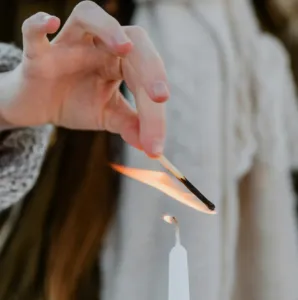
I’ve been moved to write this in response to conversations I both overheard and participated in following the death of Dolly Parton in August 2026. I heard a very mixed response, which was to be expected, given that I don’t know anyone who was actually acquainted with her. Several people expressed their shock and sadness openly and carried out their own rituals to pay their respects in their own way – lighting candles, saying prayers, listening to her music – all ways to honour her memory. I also heard some bewilderment in response to the need to carry out these rituals. A struggle to understand why it was necessary or important, or what those people were feeling in that moment. It’s a difficult one, because when we really think about it, I imagine we all have an example of a time we’ve felt our feelings were dismissed or diminished by others, and yet despite that knowledge we might still be less understanding than our grieving friend, family member or co-worker needs us to be.
Responding to grief with kindness
Perhaps there is a balance in the consideration of disenfranchised grief, that might enable us to both support those who need it and feel able to express our own grief in our own unique ways, without the instinct to judge what we might not fully understand. Maybe not, but I’d encourage everyone to think about their responses to the grief they see around them, and that they experience internally too. We could probably all benefit from being a bit kinder… to ourselves as much as to those around us.
Counselling and Emotional Support from Nottinghamshire Hospice
If this article has raised anything for you, or if you or someone you know is grieving, you don’t have to face it alone. Nottinghamshire Hospice offers free counselling and emotional support, including one-to-one sessions and peer support groups. Our team is here to help you find the support that feels right for you.
Find out more about our counselling and emotional support here or call us on 0115 962 1222