
22nd September 2026
Let’s Talk Grief: Theories of Grief (Part 2)

Grief can affect far more than how we respond to a death, and different theories can help us understand some of the ways people adapt to loss and change.
In the second of two Let’s Talk Grief articles exploring grief theories, Jenni Tompkins, Bereavement Service Lead at Nottinghamshire Hospice, looks at William Worden’s Tasks of Grief and the Dual Process Model, and how these ideas can help explain the different ways people move between loss, adjustment and everyday life.
Exploring different ways of understanding grief
Last month, we explored the ‘Stages’ theory of grief. This time, I want to focus on some of the more contemporary ideas that help to shape our understanding of grief and the way people might react to it. Again, it is important to remember that these are theories, not facts. These ideas will make sense to some people, but will have less meaning to others, and that is completely ok – everyone experiences grief in their own way, and there is no right or wrong way to grieve (I know I say that a lot, but it’s true!).
These ideas are important in developing our understanding of grief, in that they build on the work of early researchers (like Elizabeth Kübler-Ross) by introducing models that distinguish between ‘normal’ and ‘complex’ grief. Again, though, we have to bear in mind that even the idea of ‘normal’ when it comes to grief is misleading, because everyone’s experience is so different. However, there are elements of complexity that can make grief more difficult to manage, and these ideas start to shape an understanding of what that might mean.
William Worden’s Tasks of Grief
William Worden (1991) was very critical of the ‘Stages’ model of grief. He believed that it was important to recognise that grief was not something felt only in response to death, we also grieve for other losses experienced throughout life. For instance, the breakdown of relationships, the loss of jobs, friendships, children moving away. There are also micro-losses that can be associated with declining health or old age, all of which might be grieved for in some way.
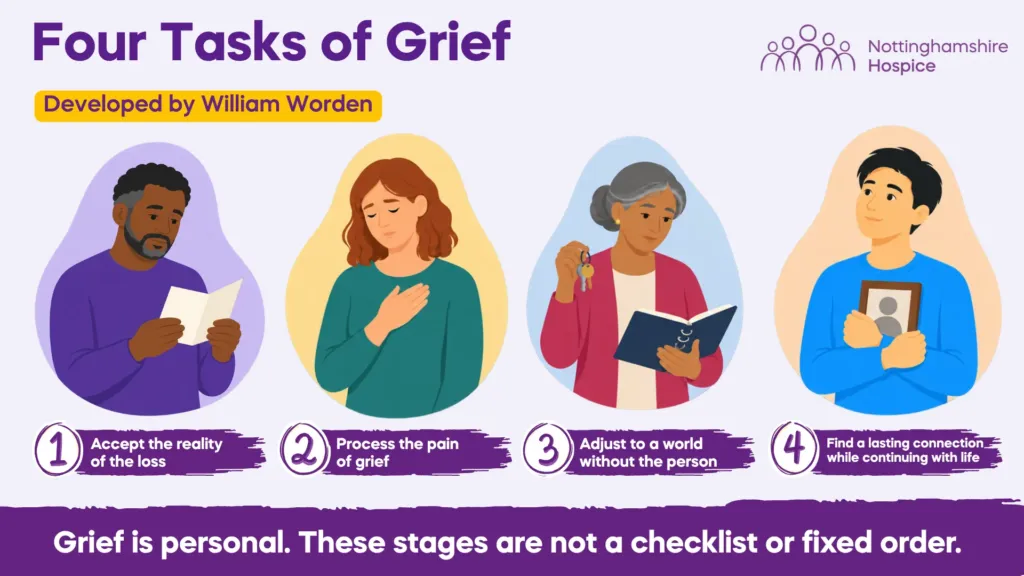
Worden theorised that grief was not a passive process, where a person drifts from one stage to another without any thought or action. His theory is based around the idea that to process grief, a person will need to work through a number of ‘tasks’:
1. Accept the reality of the loss – this includes things like overcoming the initial shock, accepting the fact that the person has died and will not return, and completing rituals such as funerals, memorials and ceremonies etc.
2. Process the pain of grief – this means a person allowing themselves to feel all the emotions attached to their grief: sadness, anger, loneliness, pain, relief etc. etc. without suppressing them or masking them. It isn’t expected that a person will do this alone – finding safe outlets for these feelings is an important part of this task. Friends, family, support groups and community groups can all play a part.
3. Adjust to a world without the deceased person in it – so this will be things like adapting to changes in everyday life and finding ways to navigate the ‘new normal’. Taking on the tasks that the person who died used to do, making new friends or re-investing in existing relationships, and attending to any alterations in world view and shifts in identity as a result of the death.
4. Re-invest in the reality of a new life – this doesn’t mean ‘moving on’ or forgetting, quite the contrary. It’s about finding a way to carry the memory of the person with us into our new reality – actively remembering them, whilst still understanding that they are no longer here.
Taking an active role in grief
Sounds simple? It does… until you’re in it, and then it’s just as messy and unpredictable as ever! What Worden is suggesting with these tasks, is that it is possible to be an active participant in your grief process, and that by attending to these things openly and without avoidance, it can be dealt with in a healthier way.
The difficulty, of course, is that grief does not occur in a vacuum or under laboratory conditions. Life happens, and it is very difficult when taking all the varying and often competing responsibilities of a person’s life into account, to put grief into such simplistic terms.
We all wear masks – it’s what helps us to get through the average day, so to be consistently open to grief and its rollercoaster of emotions would be challenging for most people, myself included!
That said, there is something empowering about the idea of having some control over the process and being able to forge a path through grief for ourselves, rather than it being something that just happens to us.
The Dual Process Model of grief
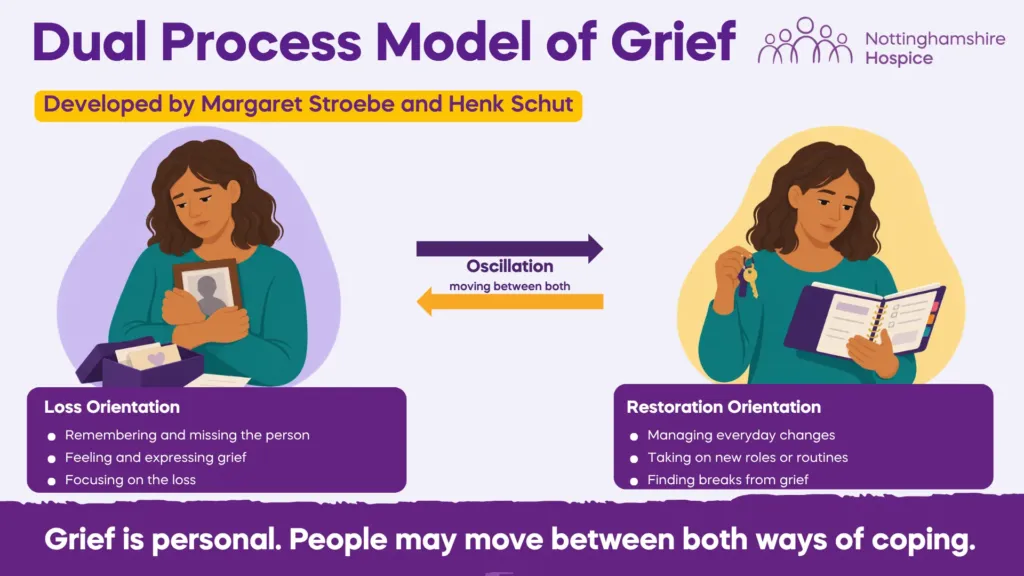
The theory of grief that makes the most sense to me is Margaret Stroebe and Henk Schut’s ‘Dual Process Model’ (1999). They theorise that there are two ‘orientations’ to grief. On one side, we have ‘Loss’; this focuses on the emotional pain of grieving, feeling the depth of the loss, expression of sadness, or visiting memorial spaces. On the other side, we have ‘Restoration’; this is centred on attending to life changes, investing in the new normal, distraction and learning new tasks, and the practical things that need doing.
Healthy grief in this model, features some oscillation – or movement back and forth -between the two orientations. There are no rules about how this will look in practice, or how long each oscillation will take – it could be minutes, hours, even days, so it means that this idea can fit very well with most people’s lived experience of grieving.
Moving between loss and restoration
For instance, things like going back to work or joining a new club might be examples of ‘restoration’, whereas crying when a certain song comes on the radio or when looking at photos or recordings of the person who died might be examples of ‘loss’. This is a really useful way to normalise the sometimes wild fluctuations that people can experience in their moods, especially in the very early days after a bereavement, and goes some way towards helping our clients to understand that what they are going through is normal, even when it feels completely abnormal!
When grief becomes more complex
This theory goes further, in suggesting an idea for what can cause grief to become more complex. Essentially, when someone becomes ‘stuck’ in one orientation or the other, their grief can be more prolonged, and therefore more complex.
Someone stuck in a loss orientation might struggle to accept the reality of what has happened and actively avoid any suggestion of living a life without their person in it. If someone were stuck in restoration, they might be more likely to be determined to carry on as normal and completely disregard any notion of struggling emotionally. Again, there are no rules about what this will look like, so it can easily take into account the often-varying difficulties that a person is experiencing in their life alongside their grief that might lead them to struggle a little more.
Grief theories are guides, not rules
There are many more examples of grief theories and models, but these are the ones that seem to have the most relevance and applicability to real-life situations. This doesn’t mean that they will hold meaning for everyone, though, so if they don’t match your experience, that’s ok! We will always strive to hold these theories ‘lightly’, in that our focus is always on the individual experience of the person in front of us, not what these theories tell us ‘should’ be happening.
What we can do is use this understanding to help normalise the process and hopefully ensure that people feel a little bit less alone on that journey, whatever it might look like.
Counselling and Emotional Support from Nottinghamshire Hospice
If this article has raised anything for you, or if you or someone you know is grieving, you don’t have to face it alone. Nottinghamshire Hospice offers free counselling and emotional support, including one-to-one sessions and peer support groups. Our team is here to help you find the support that feels right for you.
Find out more about our counselling and emotional support here or call us on 0115 962 1222